Wednesday, April 27, 2016

Response 5 - Dawn of the Dead: Who are the real zombies?

Dawn of the Dead: Who are the real zombies?
            While we watched Dawn of the Dead last week I thought over the entire genre of the post-apocalyptic zombie movie. I love these type of films and I own most of the DVD versions of these, from Dawn of the Dead (1978) to Shaun of the Dead (2007). The whole concept of being faced with this insane world and the implications of having to deal with so much death. Not just of people you know but also of the ones you don’t. The implication that all over the world this is happening at the same time, and the human race is in for it. I think these movies create a world where being human becomes so important and being a zombie is so hateful to think about that people would rather shoot themselves in the head and keep themselves from becoming one. That much distain for these monsters is not something found in everyday horror.
            The movie takes an interesting idea about the zombie apocalypse to me. The idea of when everyone who dies is going to become a zombie then what is the true difference between the undead and the people walking around waiting to die. I think that the movie takes a lot of stock in this idea when you see zombies being pitied by the director. Like when the kids come out of the closet or when the zombie sits outside the department store looking sad. The director also forces us to take pity on them when they are being pied in the face and shot with seltzer water from the bottle. The gang at the end seems so just outrageous and mean. Almost caricatures of the humans they were before. Like a traveling group of circus clowns swinging from vines and screaming random things at the drop of a hat. Riding their bikes through the mall destroying the empire which had been built by the main characters. The zombies weren’t even as bad as these people and we take pity as they are easily outwitted, and the characters slaughter them. Their fragile movements seem nearly innocent until they reach a living human.
            When they reach the living humans and begin to rip them apart we are returned to pitying the people who are actually human. The bodies nearly turn inside out as they are ripped apart in grotesque fashion with loads of gore and screaming.  We see this and realize that these zombies are monsters, and that they are undeserving of our pity. This mix of both of these things next to each other confuses the audience. Who are we supposed to be cheering for? The people who keeping finding unique ways and weapons to remove heads and destroy brains or the zombies that just looking for a hot meal and whose minds we can’t get inside?

            I think Romero knows he’s doing this and it’s a theme movies going into the future will continue to play on. To the point where in Land of the Dead (2005), the 4th installment of Living Dead movies man by Romero, the zombies can think and plan coordinated attacks on humans who are too busy living luxury lifestyles to pay attention to zombie activities and the activities of the poor. These movies Romero made are set in a world that is meant to get us thinking about the human race on the whole. If we are any different from the zombies we are claim to not be. Do we just walk around serving our basic needs? Is anything we do actually worth doing when we will all die anyway? What is human and what is zombie? These questions are purposefully not answered by Romero in his films in order to make us ponder the questions ourselves. 

Timeless Horror


Timeless Horror

     A common theme emerging, to an extent ironically, in the horror genre is that of timelessness. Horror films, and films in general, are often given the description of “timeless,” or “classic”. However, a couple of the more recent films we've screened take that description in a literal sense. The Texas Chainsaw Massacre, for example, portrays a family stuck in time. Their survival depended on a dying business; but, instead of searching for new ways to sustain themselves, they simply shifted their skills to another venue. The Thing touches on the theme of timelessness in another way: immortality. The alien has lived, as the characters speculate, for hundreds of thousands of years under the ice. Although neither film discusses the physical nature of time – or more specifically its relation to space – each inadvertently addresses it.
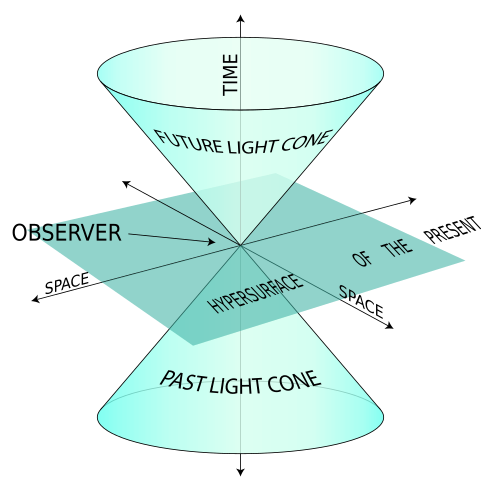
     The relationship between time and space is difficult for even experts in physics to understand. Basically – note my distinct lack of expert status – time and space are intertwined. Our world consists of, at least, 4 dimensions: 3 spatial and 1 temporal. The relationship between these dimensions is hard to create a picture of, but I've provided one of the more basic representations:

Essentially each cone represents all of the possible events leading up to and away from any single point in time. In this sense, only the present moment in time actually exists within space, while all other moments exist as probabilities – hence the decreasing and increasing number of possibilities represented by cones instead of, say, rectangles. 
      Both the family, from here on referred to as 'The Butchers,' and the alien are confined within both a time and a space for reasons they cannot control. Their situations, and therefor their evil, is a product of probability – the free market or atmosphere free-fall on an unfamiliar planet. Interestingly, the horror they present is then a product of the dissolution of time itself. The films comment on the cyclical nature of history by creating a cyclical timeline. This cyclical timeline is dictated then by a confined space – a Texas homestead or Antarctica. In the context of this conical representation of spacetime, each film forgoes the 'future light cone,' opting to instead condense it into the plane of space. This forces all future actions of the 'observer' – in this case either The Butchers or the alien – into the space they inhabit. Because any single cross-section of a cone is a circle, their future is then defined by a circular timeline existing within a specific space around the observer. In plain terms, they repeat themselves until either their space is forced to change or they no longer exist within time – they die. 
     Considering how many horror 'monsters' or 'villains' represent the fear of social constructions, the dissolution of time in these films lends a 'timelessness' to the constructions themselves. 'The human condition' is a phrase often thrown about when discussing horror representations. So when films highlight or reference the 'horror' inherent in 'the human condition' and simultaneously dissolve time in their own framing, they make the claim that said horror is itself timeless; that, as a result of the nature of humanity, it has, and will always, subsist. 

     If this projection of my interest in the physicality of time doesn't work for anyone or if I've missed any crucial aspects of the physics behind my claims, please inform me; I'm completely ready to be wrong. On a bit of a side note, I wanted to point out a few visual parallels I saw in The Thing with other media; specifically Hayao Miyazaki's Princess Mononoke. I'll refrain from making any comments on the connections I saw simply because I'm unsure of what can be said outside of proving The Thing's influence, but here is a short clip that should seem familiar...


The Thing - Extra Credit

Carpentar’s 1982 film, The Thing, has certain humorous aspects that make the character’s and the story line appear more “human” like as well as the aspects of paranoia and turning against the ones’ closest to you. Make light of a dreadful situation is just one of the many ways that human beings cope with the overwhelming stress of dangerous experiences. For instance, my mother forgot to put her car in park after she pulled into the garage and after she got out of the car, it began to roll down the driveway and into the street. As I attempted to stop the car, almost having it roll over my foot in the process, all my mother could do was laugh. Humans have ways to avert their feelings from the situations at hand.         
            The Thing is an amazing imitator and because of this, the crew in Antarctica is easily persuaded to suspect every other human in their midst. This raises the tension and furthers pushes the storyline. The way that Carpentar directs the filming of these scenes is what really allows the audience to feel the tension between these characters. The multiple times and long pauses on certain characters faces build the suspense. Those shots as well as multiple scenes where characters are going crazy, have weapons, or even hurt the others they are with, increases the audience’s perception of the anxiety the characters are feeling.
            Carpentar doesn’t let this film create an absurd amount of tension without releasing it at some point throughout the story. The most suspenseful scene in The Thing is when Mac is finally doing the heat test on his crewmates’ blood to see who is infected. After one of the men is tested positive for the infection, the man left sitting on the couch after that is one of the only one’s left to test. Once his blood is cleared, he sarcastically begins to comfort Mac and then begins to scream for Mac to untie him from the couch. The way Mac was screamed at is the part of the scene that relieves all of the anxiety from the blood test. The audience is left to laugh about it because of the sarcasm felt in the man’s voice. The tension causes the outburst from the man but the audience is able to laugh in the middle of this apocalyptic world.
            In most of the horror films we’ve watched throughout the semester, humor has not always been used to alleviate the apprehension felt by the characters in specific storylines. The Thing and Dawn of the Dead are the exceptions to that and allow the audience to not feel as frightened. The humor breaks are good for the human psyche and allow a film to be more enjoyable for the audience.


Tuesday, April 26, 2016

Response Paper 5, Marit Anderson

            According to Heather Addison, John Carpenter’s The Thing laughs in the face of masculine assertion; there are no females in the movie for the men to romance and the only attempt at a “homosexual encounter” (Bennings in the corner engulfed in the tentacles of the Thing) proves to be deadly. Addison’s article paints a rather hopeless picture of the male’s plight, but there are elements of the film she seems to ignore. Though the male has no agent over which to assert sexual dominance in the film, the character of MacReady seems to assert himself over the other characters through use of flame throwers, flares and dynamite. The prolific use of phallic weaponry in the Thing indicates that, in the absence of sexual conquest, MacReady is still able to assert himself sexually through the use of his “own member.”
            The use of shaft-like weapons, especially the flame thrower, are brought out by MacReady to visually intimidate the Thing as well as other members of his crew. When faced with the to-be-copied dog, MacReady’s first instinct is to call for Childs to “bring the flamethrower.” When Childs finally arrives he hesitates to shoot it, much to the chagrin of MacReady and, afterward, MacReady claims the flamethrower for his own, using it for the rest of the film. He uses it to torch the creatures, excessively most of the time, and to intimidate the crew during the blood test (must he really heat up the wire with such a large instrument?). It is clear from this possessiveness over the flamethrower and its subsequent uses for both domination and intimidation identify it as phallic, not to mention the fact that it is visually so: It’s a shaft which releases an emission from the end. The way MacReady uses the flamethrower throughout the film, mainly in a masturbatory fashion, shows that he does not need a heterosexual or homosexual union to assert his masculinity; He can do it all by himself.
            However, MacReady’s overzealous torching of the Thing reaffirms Addison’s identification of it as female. MacReady uses the flamethrower to overpower the thing more times than he uses it to overpower his crew, indicating that it’s destruction via flamethrower is the more important goal. This image is sexually violent, no matter the gender-identity of the target but, when coupled with the gaping vaginal holes (especially the vagina dentata that devours Docs hands) the Thing sprouts, this penetration seems to be male toward female. If, however, this interaction can be identified as a rape, Addison’s argument that there is no target for sexual conquest, male or female, becomes false. If the Thing is female and the male asserts himself on the female, via use of a long shaft-like object, then there is indeed an instance masculine sexual assertion in the film, and a violent one at that.

This encounter would then annul Addison’s statement concerning a lack of an outlet on which males can assert their masculinity in the film, specifically, the style of masculinity the Reagan era was based off of. In its place, I posit that The Thing serves to show that the Reagan-Era-Style male will, even in a wasteland, find a target on which to assert his preferred masculinity.


 A film I think would be a great addition to the class is the Blair Witch Project (Even though it's from 1999 and, therefore, after the 1990 cut-off). It's the first film to really capitalize on the "found footage" idea, which becomes an important tool in later horror films. 

Monday, April 25, 2016

Commodity Cannibalism

In George Romero’s, Dawn of the Dead, the main subject of horror underneath the blood and guts is the fear of purposelessness.  This is the main factor Marx and Engels address in their communist manifesto in the dystopian society.  They propose that through the separation of the worker from labour and his product the society becomes dystopian.  The idea behind this theory is not dissimilar to the old saying, idle hands make the devil’s works. 
This can be seen in a multitude of moments throughout the film.  Whilst the main characters hide and play house they become more agitated the less they have to do, after annihilating the zombies from the mall they have nothing to do but wait.  The zombies outside are content because they still have their focus of getting passed the doors to their meal.  
Stephen is almost useless from the start in that he cannot fight or aim a gun and is extremely inexperienced in even handling a weapon.  But he is the only one who knows how to fly a plane.  This is the reason he gets so disgruntled when Francine wants to learn to fly, because she is effectively taking away his only purpose.  And it is for this reason, I believe, he becomes a zombie.
The reason for Francine's agitation with the men during their conversation over her fetus is due to her feelings of purposelessness not because it's her body.  This becomes the one thing in the world that she can do is to decide about whether to bring this child into the world and to keep herself alive until she has at least made that decision.  Once she decides to keep it she becomes much more capable and forward about her decisions, as if to say, once you find your purpose you wont have to be a vacant zombie anymore.
Roger doesn't start to become depressed until his legs gets bitten, this is the moment when his purpose gets taken away from him and he is forced to experience the zombification of inability.  Though this is a slower process because the group still gives him tasks but once he becomes too sick to do even that, he becomes what they are all fighting to stop.
Peter has a purpose throughout and Francine gains a purpose, the reason both Roger and Steven’s zombification is they lost their purpose.
This is why the zombies never stop, because they have a clear reason for being, to eat and to consume.  It is in this way that the comment works as a dual sided attack on the current economic state.  The surface of this idea is that people are slowly becoming slaves to their greed for the things of the world and have lost whatever it was that made them human.  The comment here being that we are all mindless automatons buying and eating ourselves into purposelessness.
            I liked the equalizing manner in which Romero makes this film, in that no one survives for their place in societal hierarchy, but for their usefulness to the group.  This is a very progressive manner in which to deal out the death scenes.  This is a good thing and a bad thing for the characters in that they are all treated equal but they are all seen as not much better if not worse than the zombies.

            This is why I said, worse than face eating zombies, because the continued taunting and disrespect for the undead paints the living characters throughout the film as truly awful people.  The zombies are basically newly born children; they have no understanding of the world or how things work.  It is through this ignorance that the zombies become able to be empathized with and the humans slowly become more monstrous.

Rosemary, Reproductive Systems and Witchcraft

Initially, Rosemary’s Baby presents itself as more of a drama than a horror film, however I’ve come to realize that Roman Polanski’s 1968 film simply revisions horror without all of the blood and gore.  Instead of relying on special effects to attack the viewers, Polanski depends on his originality and ingenuity in order to create a premise that will terrify its audience.  The concept of cults, witch covens and secret societies that exist right under our noses is not an unrealistic idea.  Especially when we consider the fact that the coven of witches in Rosemary’s Baby is comprised not by our stereotypical witch image, but rather by a group of “friendly” neighbors.  This only intensifies the horror of the film, causing viewers to believe that if such horrific things could happen to a sweet traditional Catholic girl like Rosemary, then they could happen to anybody, even them.

This calls into question, how well do we really know our neighbors? Or our husbands for that matter?  Rosemary’s Baby addresses some very real and terrifying issues that women like Rosemary face all the time.  Guy Woodhouse plays an interesting role – the definition of a husband from hell.  Not only does he join a coven of witches and sacrifice his wife’s body without her consent in order to further his career, but he is also consistently undermining, overly controlling, misogynistic and blatantly rude towards Rosemary.  Guy represents the stereotypical self-centered Hollywood celebrity asshole that we see appear with a direct correlation to the accrual of fame and wealth.

The female body and the female reproductive system in particular is a huge topic of controversy that is pointed to throughout the film.  Again, we see a woman defined by her sexuality and female organs.  In Rosemary’s case, her value is determined completely based upon her body and her reproductive capabilities rather than the value of her life as a human being.  In her work The Monstrous-Feminine, Barbara Creed writes, “the witch’s supernatural powers are linked to the female reproductive system”, a concept that rings true throughout the film (77).  In Rosemary’s Baby, it is believed by the coven of witches that the most powerful blood to use in their rituals is baby’s blood.  Hence, the coven manipulates Rosemary in order to carry out their plot in which she is drugged, raped and impregnated with the baby of Satan.


The issue of women’s reproductive rights was certainly quite controversial in the sixties, and it was actually radical of Polanski to expose and critique the male dominance and control of the female reproductive system in his film.  Also, I think it is important to acknowledge the polar beliefs of spirituality versus the practice of medicine that are expressed through the different people who advise Rosemary throughout her pregnancy.  There is clearly some altercation regarding what kind of wellness plan is best for the pregnant body.

The witches and Doctor Sapirstein use a system of spiritual beliefs and “natural” remedies on Rosemary, while Doctor Hill represents new medicine.  Toward the end of the film, Rosemary exclaims, “I want vitamins and pills like everyone else” (Rosemary’s Baby).  This statement demonstrates the naiveté and instinctual conformity of Rosemary and the American public in general.  Not to mention, the entire film critques the ignorance of our society and the lack of awareness with respect to conspiracies, coverups and corruption.


Finally, I would like to point out that we see once again in this film (as we have with Cat People and others) the questioning of the mental sanity of a woman.  Rosemary is constantly at battle between what her instincts tell her and what argument Guy counteracts with.  Because she is a woman (and a pregnant hormonal one at that), Rosemary is assumed to be emotional, unstable and made to seem insane.  As it turns out, she is not the crazy monstrous-feminine afterall.

Dawn of the Dead

Aden Lungstrom
Matthew Harris
ENGL 3040
4-24-16

Dawn of the Consumer.

            This was my second time watching Dawn of the Dead and I picked up on a few things that I didn’t notice the first time watching it. With my second viewing of the film I noticed a large amount of criticism of the cultural and economic roles that played in the American society in the late 70s. The view and allegory for consumerism is pretty much a given for this film, however what I noticed the most was the historical representation of the Cold War and the fear of communism. The question of “who is who?”. Even though the Red scare and McCarthyism were at its peak in the mid-60s, the aftershock of the hysteria lingered in films like Dawn of the Dead many years later. 
In the film, we the audience, witness a small group of American survivors fight an enemy which looks human but in undead. Romero played with the idea that these zombies were the communists of the film, but in fact I would argue that the zombies played the role of the common American consumer, or capitalist, and the survivors played the role of the communist. When the survivors arrived they are greeted by a massive horde of zombies, in this case the survivors are the foreign invaders that need to share resources in order to survive.  These survivors had to live in a socialist community in order to survive. The zombies, a community that thrives on consuming, did not take the survivors presence too kindly. However they slowly picked off the survivors one by one until Peter and Francine flew off. The context behind these allegories is that in 1978 communism was still a threat to the American society as well as the problems it created by using extreme solutions.
When there was a broadcast there were usually two people on the show the host and an esteemed scientist. However the scientist’s opinion of how to deal with the zombies kept changing each time. At first the scientists wanted every viewer to know that these creatures are not human and should not be treated as such. Even if they were a neighbor, family member, lover, whomever they should be exterminated immediately. The mindset of the scientists is similar to how authorities dealt with communists in America. McCarthyism played much of this role in history, if someone knew or found out that they know a communist it was their “American duty” to liquidize the threat.  In this case the zombies play the role of communistic invaders. After all, the fear was of the domino effect that would spread much like disease across America. This fear is identical to how quickly the zombie epidemic is represented in the film, all it takes is a bite and there’s no going back.  Eventually the scientist’s opinion changed; in the last broadcast the scientist suggests taking the “logical approach” and feed the zombies. Even the host begins to question him, his response is “we must remain logical”. It is possible the scientist was making a contemporary comment to aftermath of McCarthyism.  Perhaps the argument of  there is no escaping the idea of communists being in America, instead we should begin to understand them and see what they have to offer.

The allegories of the red scare are heavily present throughout the film; however it is difficult to tell at times who exactly the communists of the film are. Both the zombies and survivors share similar roles as individual consumer,  yet also have the roles that show case a communistic society.  I thoroughly enjoyed this film and the unique political commentary that it provided.